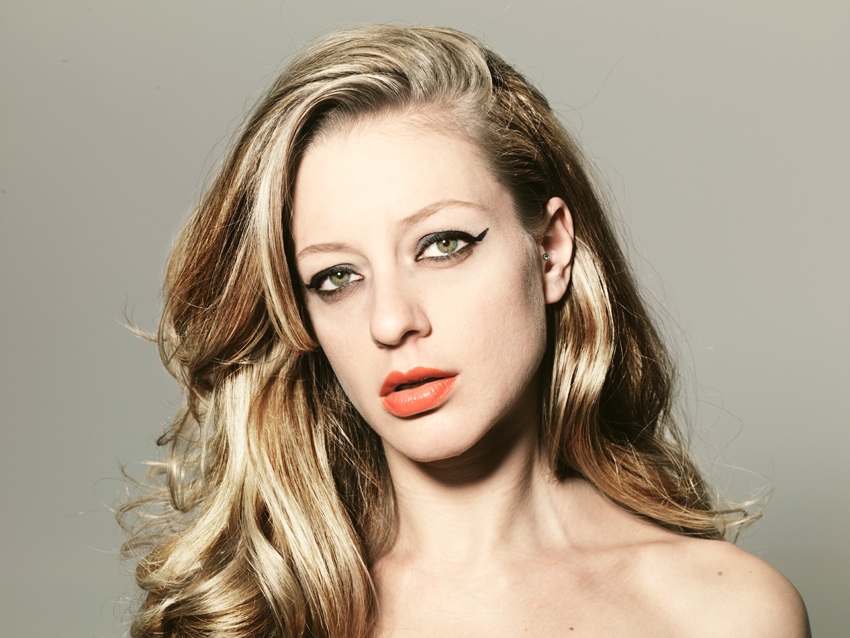
Friday, 2 December 2011

Mari Wilson Interview

Often imitated but never bettered, Mari Wilson's beehive ranks among the most iconic hairstyles of the eighties. In the decade that taste forgot, only Annie Lennox's flame-haired crop and Boy George's androgyne dreadlocks commanded more column inches.

Mari burst onto our teatime TV screens in 1982 like a bolt from the blue. Not because of her camp-as-Chrimbo backing band The Wilsations (though 'Hank', 'Curt' and 'Wilbur' weren't exactly an eyesore) - no, it was that foot-high beehive teamed with floor-length lame on 'Top of The Pops that made the 27-year old an instant star. And it didn't hurt that her song 'Just What I Always Wanted' was an irresistible slice of retro-pop that wouldn't have seemed out of place on the Sweet Charity soundtrack.

"People just weren't dressing up then!" Mari remembers when I chat to her in a Clerkenwell studio. "It was just after punk, and it was really unusual that I was dressed to the nines with a 12-piece band. And then afterwards of course there were The Eurythmics and ABC - bands that were all about dressing up."

And while Mari never had the shock-value of Pete Burns or Adam Ant, she was no stranger to controversy, with the Daily Mail (quelle surprise!) cattily remarking "Mari is dogged by the fact that her hairstyle has always been bigger than her recording successes.' Ouch. But for better or worse, everyone was talking about her.

And then, after a Smash Hits cover and string of Top 40 hits, she did the unthinkable. "In 1985, I walked away from my record contract. And it's usually them dropping the artists! But I was really unhappy, and I wouldn't make the high-energy Hazell Dean records that they wanted.'

Now at the age of 57, Mari's plunging her energies into two wildly different projects: a witty dance single 'O.I.C.' with London producer BoiSounds, and a stripped down covers record to be released in early 2012. She now lives in Crouch End, London with her 14-year old daughter, and, free from the manipulation of record company bigwigs, she's able to pick and choose her projects. And although her hair-hopping up-do has been replaced with a sleek bob, she'll always be Queen Of The Beehive. Just don't try to get between her and her Bristows.


So how much hairspray did you used to get though?

We ordered it in crates! We used this brand called Bristows, and it stunk! To begin with I did it myself, and then when I got more well-known my hairdresser Peter started to travel with me everywhere. The bigger I got, the bigger the beehive got - just like Amy Winehouse's! When we went to tour America, they tried to stop us taking our crate on the plane, and I said "[gasps] we have to, we have to!" They let us in the end!

Did you wear a hair piece?

No, it was all my own hair, all of it. Peter used to put heated rollers in, spraying as he wrapped the hair around them. And then the rollers would come out, and it would backcomb it all until I looked like Eraserhead! And then he would sculpt it. It was amazing, really. In fact, I met Joanna Lumley a couple of years ago….

Well she did Patsy in Ab Fab, who had an incredible beehive as well.

Exactly! Someone introduced us, and she said 'Mari Wilson? I bow at your feet! You're the one with the real beehive - how could mine compare?' [laughs]

Have you ever had drag queens doing you?

Oh yeah! And I've had male fans in the eighties that would come to the gigs in beehives, dressed up as me!

And how did they look?

Not great, to be honest! But I'm quite happy for people to send me up.

Well, that's something I've always liked about you. I was watching the video for 'Just What I Always Wanted' earlier, and there's a bit on Brighton pier where a boy looks at the candyfloss, then the beehive, and he's like 'huh?'

Oh yes! [laughs] I quite like camping it up and having a laugh.

And what about your new record? Why did you want to do an album of covers?

Well, for the past few years I've been gigging with just two musicians - I call it Mari Wilson's Threesome! And it's a very torchey kind of performance, and totally different from my last album 'Emotional Glamour', which was very sixties and very produced. So I thought it was about time I recorded these songs. And although they're covers, every song is completely different from the original.

You slow it down?

Yes. I've done 'They Don't Know' by Kirsty MacColl, and 'Don't Get Me Wong' by The Pretenders - which has such beautiful lyrics. When you slow it down, you can really hear the poetry. And I've covered a song by a new artist that I love called Caitlin Rose.

Oh, wasn't she discovered on Youtube?

I didn't know that! But isn't everyone these days? I think that record companies are very much involved with making it look like that.

There's always been myth-making around artists though.

Oh yeah, and that's part of the fun! I remember in 1982, my manager Tot Taylor called up the Evening Standard and told them that David Bowie had been spotted in HMV buying a Mari Wilson record - and they printed it! And why not? I quite like the whole fantasy thing, that's exciting for me. I don't mind all that.

An edit of this interview originally appeared in the December 2011 issue of Beige

Sunday, 7 August 2011

ICONIC: Winona Ryder


Isn't it everyone's dream to have eternal youth? Dorian Gray sells his soul for it, Michael Jackson built Neverland in an attempt to cling on to it, and 'Winona Ryder' made a whole career out of it.

Contrary to popular belief, 'Winona Ryder' only lived from 1986 to 2001, when her star was tragically extinguished by an unfortunate brush with reality in Saks Fifth Avenue, Beverly Hills. The incident left Ms Ryder fighting for her life and her career, but the outcome was not positive. She enjoyed just fifteen years under the Hollywood sun.

The slim-limbed and fresh-faced Winona, who was born with the surname Horowitz, was one of our last great actresses. Her star was born on the back of a small but hugely significant role in the football comedy Lucas in 1986. As Corey Haim's best friend she shone with winsome charm amidst a rabble of teen co-stars (among them Charlie Sheen), and even when puffing on a clarinet maintained dignity and grace.

The rebirth of Winona Horowitz as 'Winona Ryder' ranks with the greatest of Tinseltown transformations, like the legends Norma Jeane (Marylin Monroe) and Audrey Ruston (Audrey Hepburn) before her. Winona's entrance to this Hollywood pantheon of stars came just a decade before it was brought to ruins by the Internet and reality television shows in the late nineties.


Winona's 'type' was The Hyperbolic Heroine: a regular kind of person multiplied by ten. When faced with an alienating high school clique in Heathers, Ms Ryder takes the drastic measure of poisoning her best frenemy with bleach before blowing up the school. The rebellious daughter to Cher's hip-swinging beehived Mom in Mermaids? A retreat into devout Catholicism is really our young heroine's only option. And as a misfit teen in Welcome Home, Roxy Carmichael, founding a sanctuary for farm animals and casual goth styling will surely help with the playground teasing.

Throughout her defining roles she remained a beacon of dewy insouciance and an immortal vision of youth, but the tragedy of 'Winona Ryder' is that she never reached adulthood. As she entered her thirties, she was still playing a closeted sorority leader in love with Rachel in Friends ('I can still hear the coconuts knocking together!'), and the high-school cool girl subjecting a 46-year old ex-junkie to a makeover in Strangers With Candy.

'Winona Ryder''s death-by-shoplifting is to Hollywood what Macbeth is to theatre, a cursed legend only referred to in pseudonym or hushed tones. Alas, her last great performance – on the witness stand – was not captured on celluloid, and she was consigned to the Hollywood scrap heap.


After noncommittally haunting The Private Lives of Pippa Lee and A Scanner Darkly, the ghost of 'Winona Ryder' horrifically returned in Darren Aranofsky's Black Swan last year. As the washed-up ballerina Beth Macintyre, Winona rattles through the picture like an unhinged poltergeist, a psychobiddy caricature of middle-age. Like Bette Davis as Baby Jane before her, she is a spectre of youth; art and life were never so cruelly and deliciously intertwined. 'Did you suck his cock?' she drunkenly slurs at Natalie Portman before throwing herself in front of a car. Winona's visage, once the face that launched a thousand scripts, is brutally torn to shreds by her own fair hand. 'I'm nothing!' she cries, stabbing her porcelain cheek with a nailfile. 'Nothing!' she shrieks, writhing and foaming at the mouth. She lays down dead, finally exorcised.

As Jocelyn Wildenstein discovered and continues to discover on a daily basis, the elixir of youth is a double-edged sword. What Winona Horowitz does now is neither here nor there; like River Phoenix before her, 'Winona Ryder' never grew up.

Wednesday, 3 August 2011

Stevie Nicks - In Your Dreams Review


Joni may have turned to jazz, but in her seventh solo album Stevie's sticking to her folk-rock guns. There's nothing here to rival the bootylicious swagger of Edge of Seventeen, but Stevie's self-consciously witchy chanteuserie remains incomparable. Plundering Edgar Allen Poe in Annabel Lee and, bizarrely, Twilight: New Moon in Moonlight (A Vampire's Dream), Stevie reworks occultist narratives into driving pop melodies. The album's best song is the sparse ballad For What It's Worth, the swansong of an impossible relationship and the song that she needed to live through addiction and heartbreak to write. In more ways than one, it's the record of a lifetime.

4/5

Tuesday, 12 July 2011

You can be in Mel Merio's new video, if you like


"I'm so tired, I didn't go to bed till 6!' Viennese pop star Mel Merio exclaimed when I met her at her London show earlier this year. Oh, raving till the early hours? In fact, no. "My housemates were having a party and they kept me up - I just wanted to go to sleep!"

Not that you'd assume such a homebody from her music. Her first single 'Lovemore' was a sublime slice of Roisin Murphy-esque glacial Italo, and now Mel returns with a collaborative video project for her new single 'What's The Big Deal'.


01 What's The Big Deal (Original) by Sainted PR

“We want to give you the possibility to present yourself in this video," says Mel. "You’ll need to sing along or lip synch, but also feel free to write your stage-name, website, slogans or whatever you want on a poster, your clothes or even on your body."

If you want to join the likes of confirmed contributors Amanda Lepore and Peaches in the video, here's what you need to do:

1) Film yourself in hi-res singing along to 'What's the Big Deal'. The lyrics are here.
2) upload the whole, uncompressed file to Sendspace
3) Set the recipient's email to mel@melmerio.com

Hurrah!


Tuesday, 28 June 2011

Boys' Own Story: Interview with Nico Muhly


For Nico Muhly, there are two types of people: those that are good at being online, and those that are bad at being online. 'I live a life which is basically online/offline all the time,' the 29-year old composer says from his apartment on the Northern fringes of Chinatown, New York. 'I heard a report on the radio two days ago about how young people have different online and offline identities, and you think 'hmm, kind of...' But there's a huge permeability there.'

Nico has a deft hand at merging the esoteric and the ultra-modern. In addition to releasing his own acclaimed, genre-eschewing modern classical releases Speaks Volumes (2007) and Mothertongue (2008), in recent years Nico has become the most sought-after collaborator for indie bands experimenting with orchestral arrangements. Anthony Hegarty, Jonsi, Grizzly Bear? Check, check check. Philip Glass, Laurie Anderson? He's known them for years. Bjork? Duh. Essentially, he’s the Nicki Minaj of the classical world.

For the past two years, Nico has been working on Two Boys, an opera about gay cyber-homicide that opens in London this month and will transfer to New York in 2014. The piece is loosely based on a notorious 1990s internet murder which happened in Manchester.

'The opera begins with the fact that there's a boy that's been stabbed, and another boy who's been seen stabbing him on camera,' he explains. 'And there's a policewoman who has to figure out how and why this happened; she's essentially a creature of the analogue world, and we trace her journey into understanding what the dangers, possibilities and ecstatic moments of a life online could mean.'

The policewoman, played by the 'wonderful' Susan Bickley, uncovers a digital world previously unknown to her, where physical location is irrelevant and identity mutable.

Two Boys

'I think one of the things the Internet does is de-specify people,' Nico says. 'You can be chatting with someone that’s saying they're in London, but actually they're in Singapore and a different gender and the wrong age. When the boys are IM-ing in Two Boys and one says 'what do you look like?' all of a sudden there's a picture of a girl. That moment is an intimacy; it also happens to be a lie. To me, that is an enormously exciting dramatic moment, and it reminds me of the shifting identities in Mozart or Rossini, and which you see as long as there’s been opera.’

If anyone was going to transpose the old world of opera into a digital context it would be Nico. He talks enthusiastically and expansively, casually littering his conversation with polysyllabic bon mots and Classical references, with his tone falling somewhere between music dork and old-school camp.

The latter is not particularly surprising, given his upbringing surrounded by gay separatists. 'It's fair to say that my parents were pretty bohemian, and some of my Mom's best friends were Radical Faeries,' he says nonchalantly. 'It was a very queer-normative household in a genuine sense. It didn't feel different.'

But amid the 'strange polygamist configurations' that went on, the 11 year-old Nico took to his piano and joined a boys' choir. 'It was incredibly rigorous,' he recalls of the Tudor hymns that he memorised as a boy. 'But if your mind is open to it, it can turn very quickly into an academic pursuit while never abandoning the beauty of it. I feel like if you're gonna know a thing, you might as well know it to the bottom of it.'

There’s a frenetic energy to his conversation which perhaps goes some way to explaining his extraordinary work output. I wonder aloud where his drive comes from. 'At the moment there's this unspeakable debate about whether gays should be in the military in America, which is so crazy on a really fundamental level. If you're putting a flaw on someone's willingness to perform a public service you're basically saying they're not citizens! So for me as an artist, I feel an especial drive to achieve consistent excellence, just to prove that I am citizen of something, if not the country where I live.'

After all, the majority of Nico's indie-world collaborations have been with gay musicians. 'I sometimes find myself in these weird situations, where the only answer is just this weird queer supremacy, where you just think 'let straight people be late for the bus, and let straight people not know their music, and all us queens are gonna get our shit done.' It doesn't mean anything, it just means that it's done! There's no connotation except the fact that we're awesome.'

Like the narrative of Two Boys, Nico's story bridges the gap between analogue and digital: bookishly steeped in tradition and literary references, but constantly travelling and tied to his iPhone. Throughout our conversation, an image of him struggling with opera manuscripts on the seat-back table of an aeroplane keeps popping into my mind.

After our conversation I get home and check Facebook. I have a Friend Request from Nico. "I'M E STALKING YOU!' reads the message. I'd expect nothing less. Say what you like about Nico Muhly, but this queen is getting his shit done.

An edited version of this article appeared in the June issue of Attitude.

Jessica 6 - See The Light Review


The offshoot of New York nu-disco darlings Hercules and Love Affair, Jessica 6 delve into soul and synthpop on their mesmerising debut. Trans frontwoman Nomi Ruiz is a 21st century Amanda Lear, giving the three-piece's oft-eerie electronica a liberal coating of androgyne honey. Album highlight is reunion with past collaborator Antony Hegarty Prisoner of Love, where the chilling refrain 'why was I born only to be a slave?' takes the clipped strings and Game Boy bloops into 4am anti-anthem territory. The early-90s RnB groove of Freak The Night sounds like a lost Babyface production, while In The Heat shimmers with the instantly-timeless feel of a disco floorfiller. Forget Hercules, this is your new love affair.

4/5

Bon Iver - Bon Iver Review

Past collabs with Kanye and Nicki aside, no-one trades in six-stringed falsetto isolation like Justin Vernon (a.k.a. Bon Iver). Marching drums on opener Perth pummel us into vulnerability, but the emotional soccer-punch is in the spare, looping instrumentation, which veers from glitchy feedback to Orinoco Flows ambience. As in life, the heartbreak's in the things that can't be said. Breathtaking.

4.5/5

Friday, 20 May 2011

Q&A with Nomi Ruiz of Jessica 6


If you've seen New York nu-disco pioneers Hercules and Love Affair live, you'll know all about Nomi Ruiz. She commands the stage like a 22nd century Amazonian princess, mesmerising you with her towering presence as much as her honeyed soulful vocals. Nomi's new band is Jessica 6, who take the disco of Hercules and Love Affair and run with it into RnB, pop and psychadelic territory. Ahead of the release of their debut album 'See The Light', I caught up with Nomi to find out more about her new project.


How does the aesthetic of Jessica 6 differ from Hercules and Love Affair?

We work very intimately with one another. None of these songs or sounds could exists without each other.

How would you describe the sound of your album 'See The Light'?

I like how someone recently described it "Paradise Garage, New Jack Swing, Noir Pop and Disco Soul, all with a pronounced twist of rugged R&B"

Why did you choose to name your band after a character from the cult classic Logan's Run?

I think we liked the way the word rolled off of our tongues and also reminded us of Vanity 6 and Apollonia 6.

What's your favourite outfit to wear on stage, and where do you get your style inspiration from?

I love clothes that show off my silhouette, have movement and reflect light. My style is inspired by Stevie Nicks, Vanity 6 & Tina Turner

What is the ideal place you'd like your record to be played?

In Angelina Jolie's iPod

The video for 'White Horse' recalls a sexually-charged pre-Guiliani New York. Do you feel that that kind of New York still exists?

It does in me!

What's the most memorable gig you've ever played?

I remember playing at show in Zurich at a venue called Stall 6 and feeling like I was removed from my body. I was sweating and crawling, running up and down stairs and felt like we were all super connected for some reason.

Who are your biggest musical inspirations - for 'See The Light' and in general?

For me: Nico, Michael Jackson, Britney Spears, Silver Apples, Fleetwood Mac and Mary J. Blige

What was it like to be reunited with Antony Hegarty again on 'Prisoner of Love'?

It's what I have dreamed of ever since I first heard Antony's voice.

Your press release describes you as 'super talented 'hipsters''. How do you feel about that term and what does it mean to you?

I think it's rude and they should change it.

What's your sound of the summer for 2011?

'See The Light' by Jessica 6

If this album was a smell, what would it smell of?

Sweat and Coconuts


This interview was originally for attitude.co.uk

Wednesday, 20 April 2011

Patrick Wolf - Lupercalia Review


Taking its name from an ancient pagan festival to purify health and the city, Patrick Wolf’s fifth album finds the notoriously obtuse singer in a newly joyous mood. Lupercalia strips away the conflicted rawness and theatrical aestheticism, replacing it with humble themes of urban domesticity and love. The pop melodies are bolstered with oom-pah horns and lush strings, but the lyrics are emotionally expansive and the songs have room to breathe. Bermondsey Street is an anthem of bisexuality and the universality of love, while Patrick extols ‘scatter my ashes on this place’ in forthcoming single House. It’s not a death lament but an ode to life; the album’s working title says it all: The Conqueror.

4/5

Marques Toliver Feature


‘That’s fresh!’ says Marques Toliver when I tell him that listening to his EP, Butterflies are Not Free, is like a bolt from the blue. The 24 year-old Floridian turns up for our chat with his afro towering above other pedestrians and boyfriend in tow.

'This is Tom,' Marques introduces us, his white teeth gleaming and eyes twinkling. Given that so many musicians choose to remain sexually ambiguous when launching their careers, his candour nearly knocks me for six. Actually, it makes sexuality into a non-issue.

Butterflies Are Not Free is a unique fusion of Marques' influences (think of a jam session between Vivaldi and Stevie Wonder with Destiny's Child on backing vocals). It’s a 4-song multi-instrumental mythopoeia that tells of one man's journey to find himself, and contains some of the most beautiful gay love songs you’ve ever heard.

Marques sings from the heart, howling and caressing the soul of his compositions with his expansive baritone voice. I'm inspired by stories,' he tells me. 'The first track 'Charter Magic', is named after the magic in Phillip Pullman's Dark Materials - but I also get inspired by some little poetic blurb posted on Twitter.'

Who's his dream collaborator? 'I'd have to say Beyoncé. I couldn't say what kind of record we'd make though - it would probably be a whole new style of music!'


This article appears in the May issue of Attitude, out now.

Planningtorock - W Review


W is a sublime synth chamber piece from Bolton-to-Berlin Wanderer Janine Roston (aka PTR). Less upbeat than her 2006 debut, W creates a layered soundscape which is sometimes threatening, but utterly entrancing. Living It Out shimmers with Roisin Murphy-esque Italo, while Roston’s vocodered vocals have an uncanny alien empathy. This isn’t wilful obscurism – W has the off-beat anxiety of the best pop.

5/5

Tanjong Rhu Article

Boo Junfeng

Boo Junfeng’s film is a cry in the dark, a howl against the insidious homophobia of the Singaporean Government, who in November 1993 entrapped 12 men in a coastal cruising ground called Tanjong Rhu. The victims were charged with 'outraging their victim's modesty' and punished with prison sentences ranging from two to six months, along with three strokes of the rotan cane, which leaves permanent scarring on the buttocks.

For the then 10 year-old Junfeng, the events left an indelible impression. ‘I remember my teacher in class telling us not to go there because there were perverts lurking in the forest’, he recalls, speaking from his Singapore bedroom.
The film Tanjong Rhu was banned in its own country just days before its premiere ('I still haven't received any official response why', says Junfeng) the film is now seeing the light of day as part of the latest instalment of the ‘Boys on Film’ DVD series, which is titled ‘Pacific Rim.’ Pun intended, presumably.

Still from Tanjong Rhu

The facts are ugly, but from them Junfeng weaves a beautiful and meditative film about love in the face of institutional homophobia. His 19-minute short focuses on a young man named Kelvin and his reflections on Tanjong Rhu a decade after being arrested there by a plain-clothes police officer. The clincher: Kelvin was not just looking for sex, but returning to the place where he met his dearly-missed ex-boyfriend David.

‘I’m actually quite a romantic,’ Junfeng tells me. ‘I wanted to suggest that a relationship beyond just sex that could have come from a place like Tanjong Rhu. Especially in the pre-internet early 90s – these were the only places that gay people knew how to socialise and communicate.’

Shockingly, gay sex is still criminalised in Singapore. 'In the Seventies, Bougis Street in Singapore was well known for its drag culture, but now it's just a shopping street,' Junfeng says sadly. 'They're trying to project an image of being a progressive world-class city, but they're desperately making all these symbolic gestures that really don't mean anything.' Tanjong Rhu counters this, showing the film’s titular cruising ground not as a place of illicit sex, but as a locus of desire in the face of a society dominated by tradition and conservatism.

In the film, Kelvin's flashbacks show the romance and physical intimacy between him and his ex David. While happily accepted by Kelvin's grandmother in her home, theirs is a love that cannot be communicated in public. Particularly heartbreaking is a close-up of the lovers' hands as they walk down the street. They brush fingertips, longing to touch but unable to. The image speaks volumes about the Singaporean attitude to homosexuality: don't ask, don't tell.

'But I feel most at home in Singapore,' Junfeng says, his love of his home city clear. 'If you come here, you have to come to the gay district - on Sunday it's Boys' Night!' For now, it seems, Junfeng is happy where he is. 'All we need to do is constantly challenge the authorities and hopefully things will get better.'

And with the tenderness of Kelvin and David's relationship as memorable as the beauty of Tanjong Rhu's frames, it might just be that love can save the day.

This article appears in the May issue of Attitude, on sale now.

Monday, 11 April 2011

Glasser Live Review


Photo by Holly White

XOYO, London, 22/2/11

'I feel like Janet Jackson at the Superbowl!' Unlikely words to come from the mouth of Cameron Mesirow (a.k.a. Glasser), but when your gingham petticoat rips on the heel of your platform clogs, what's a girl to do?

Riding a wave of critical acclaim in the wake of her 2010 debut Ring, a home-recorded ouroboros of interweaving vocals and ambient electronica, the 26-year old has fast established herself as a unique and captivating performer. Mesirow's ethereal vocals and striking outfits (tonight she is a Japanese warrior come pop-pom pirate) have led to comparisons with Bjork and Joanna Newsom, but her show is less about a natureres sensibility than a thoroughly contemporary sonic melodrama.

During set opener Apply, her soprano voice cascades over maritime foghorns before menacingly shrieking to the song's close. She resembles a sexually-powerful shamanic princess, her body convulsing to dissonant xylophones and timpani drum rhythms. On Mirrorage she is a glacial chanteuse, her vocals breathy and alluring over the Italo-influenced beats. Mesirow is at her best, though, when her vocals are accompanied with the merest of instrumentation. On T, woozy drunken synths frame a heartbreakingly self-effacing love song: 'I will cut all the blues, to decorate your room.' You feel that her headress is less a décoratif than a protective helmet against the aural depths she plumbs.

This review appears in the May Issue of Clash, out now.

Friday, 11 March 2011

Yelle - Safari Disco Club Review


If Yelle were jumping rope on their 2007 Pop-Up, Safari Disco Club is when they come back bloody-kneed. Less bouncy than their debut, the three-piece’s sophomore effort takes the party into darker, more emotive territory. The synths by turns recall the swooshy warmth of fellow Gallic knob-twiddlers Air, before going all glacial Twilight Zone on us. The sad, sweet C’est Pas Une Vie hand-claps and bleeps its way through winsome vulnerability, while Mon Pays is a riff on the age-old ‘love you or leave you?’ dilemma, rendered in the coldest of Italo beats. It’s not quite The Party’s Over, but Safari Disco Club is crammed full of melodies to get stuck in your head and your heart.

4/5

This review appears in the April issue of Attitude, on sale now.

Vivian Girls - Share The Joy Review


‘Should I call Johnny?’ asks Kickball Katy to Cassie Ramone. Not a scenario from Dreamphone, but one of many delicious lyrical epigrams on Share The Joy. The Brooklynites have switched shoegaze for psych on their third LP, which is choc-full of fuzzy indie-pop wonders. The addictive and conflicted album opener The Other Girls showcases a new introspection and maturity, though.

4.5/5

This review appears in the April issue of Attitude, on sale now.

Hunx and His Punx - Too Young To Be In Love Review


On paper, Seth Bogart (aka Hunx) ticks all the boxes. Catchy three-chord songs, a badass backup girl group called The Punkettes, lyrics about heartbreak and (not) being too young to be in love. Last year’s Gay Singles was a witty twist on the conventions of Spector-esque pop – it queered up rock and roll. But on Too Young to Be In Love, Bogart’s bubble rather droops. This pastiche of 60s girl groups is missing the heart of darkness present in the best of the genre. The songs are catchy enough: title track Too Young To Be In Love chugs along melodically, but the stroppy Bad Boy lacks bite. And while it’s all in good fun, you’re left wishing there was more.

3.5/5


This review was originally published in the March Issue of Attitude.

Veronica Falls/The Loft/Comet Gain Live Review


The Lexington, London 5/1/11


'Rose rose rose red, will I ever see thee wed?', intones Veronica Falls' Roxanne Clifford as prelude to the night's opening set. It's the lament Shirley Collins would sing if she had been kidnapped by the cast of The Wicker Man. The London based four-piece, who are currently recording their much-anticipated debut album, deftly navigate psych and C86 influences while retaining a firm sense of Spector-esque melody. Performed live, 'Found Love in A Graveyard' is charged with a new frenetic urgency, while new song 'Come On Over' is a paean to love in all its torturous longing with a hook that just won't quit.
From new routes to 80s roots, The Loft deliver a pitch-perfect set including seminal singles 'Why Does The Rain?' and 'Up The Hill and Down The Slope.' As one of the first bands to be released on Alan McGee's legendary Creation Records, the band were at the epicentre of the mid-80s indie revival, and it's heartening to see their irresistible tunes being embraced by a new audience.


Tonight's headliners Comet Gain take the notion of 'cult' to a new level. To their devotees, the band epitomise pre-2.0 DIY indie, where mixtapes are cherished and bands are discovered through zines. The band take a couple of songs to find their feet, but when they launch into 'If I Had A Soul' and 'Beautiful Despair' they are taut and energising. David Feck's course off-key ramblings are tempered by Sarah Bleach's winsome, meandering patter ('It's like watching a band practice!' my gig-companion enthused). During their closing song, fan-favourite 'Movies,' Feck whispers 'it's only music, and there's much more to life than music.' If there were ever evidence to the contrary, it's Comet Gain.


This review appeared in the March issue of Clash Magazine.

Friday, 31 December 2010

Two Thousand and Heaven

The craziest party in London this year is gonna be GutterSlut at East Bloc. It's a night put on Dalston Gay Mafia, a loose collective of promoters who've re-enegised London's nightlife in the past few years. Join me there to get down to Italo disco and slutty Chicago house in the company of hot queer kids, drag artistes and weirdos! The venue's a weird maze of tucked-away rooms with beds surrounding the main dance floor - perfect for when you need a 'time out' from the sweaty melee.
Save some energy, too, for Horse Meat Disco's 48 Hour blowout on the 1st and 2nd of January. The legendary Gymkhana takes over The Eagle for two nights, where the HMD regulars will play slutty disco to the regular crowd of beary, cruisey and up-for-it guys. I'm super-excited!

Friday, 10 December 2010

Andrew Milk is obsessed with dogs


Photo by Billy Easter

Meet Andrew Milk, the hottest ginger bearcub in London. For the past two years he's been the face of the DIY queer scene here, putting on shows at his night Club Milk and playing in his dance-punk band Covergirl. I always noticed him at shows, but we first actually met at a run-of-the-mill houseparty in South London this summer. Andrew had taken over a room and was getting down to pop songs, much to the chagrin of the musos in attendance.
One grey friday night a couple of months ago, he invited me round to his place above a record shop in Notting Hill, London. I showed up late proffering beer and back-issues of BUTT as ice-breakers, and found him in his fly-posted bedroom watching telly.

What are you watching?
Roseanne. With, apparently, Joan Collins! It's her Dad's funeral and Joan Collins is meant to be her cousin.

Joan Collins: …But I really think that this is a time for families to be together.
Roseanne: Yeah, death is such an ice-breaker. [studio laughter]


She's shit!
[laughs] She's so bad. It's embarrassing, but I'm really not very familiar with Roseanne.
Oh I love it. I watched it all the time when I was growing up.
Where did you grow up?
Dunstable. It's a really small town an hour's north of London with no train station.
So what was it like growing up there as a young homosexual?
Pretty boring. A lot of waiting for something to happen that never did. There was this one effeminate guy that was friends of all the cool girls, and when he was 13 he ran away with this 22-year old man.
Oh my God, that's my dream.
He was living my dream as well. But everyone was quite obviously shocked - he just disappeared from school.
That's my next interview right there! I'm sure it all ended in tears! [laughs] So tell me how you came to start Club Milk?
It was actually started by a guy called Matt who was putting on experimental music nights when I was at art Uni in Maidstone, Kent. I joined that and it became semi-popular among the art students there, and we moved it to London in 2008. It kind of became my baby, and I was trying to turn from an experimental night into something that was a bit more underground punk/queer orientated. I was living in a warehouse in Manor House at the time, and for the first show there I put on Drunk Granny, Internet Forever, Trash Kit and Chaps, who were the first band we released on Milk Records. Everyone that was involved in DIY or queer stuff came to that show, and I guess that established Milk in London. Homocrime had catered to a similar crowd, but they stopped doing shows in 2006.
What was Homocrime?
Homocrime was these guys called Irene and Daniel who put on DIY queer punk shows in London. They would try to do a release for every show they put on, these really nicely packaged CD-Rs. They've got a website where you can download all the stuff they released, which is a really good record of what was going on in London in the mid-2000s.
That's amazing.
I'm the kind of person that's really optimistic about what one person can achieve. When I really like a band, I want to put on all their shows and be involved in every aspect of it.
How would you describe the way your band Covergirl sounds?
It's kind of guitar-driven but there's a little bit of a synth noise underneath it, so it's dance-punk! And then there's loads of vocals, and tribal choruses from everyone. Sometimes it's shouty hardcore vocals, and sometimes it's rap. So a fusion band!
Who else is in the band?
It's like a supergroup! And everyone else's other stuff is getting quite big - [Rachel's band] Trash Kit are big, [Billy's band] Wetdog are big, [Kat's band] Peepholes have got an album out now, and Ruth's becoming quite a busy artist.
Rachel was telling me about your first show at The Joiners.
Yeah, our friend Richard asked us to play at his karaoke night at the The Joiners Arms - Tranny Tuesdays! We got these black plastic eye masks and put diamanté diamonds on them and stapled them from the reverse so you could see the jaggedy stables, so it was like dangerous and punk still.
Very glamorous.
And then - you know the multi-coloured ribbon you get in corner shops when you go into different parts of the shop? - we had that underneath the masks and going down to the middle of our bodies.
Rachel was saying 'oh, we forgot to bring drumsticks, so we ended up using kitchen utensils!'
I think we ended up using a wooden spoon and a spatula as drumsticks. We played at like 1am and seven people were there, but it was a really good first gig! I'm really pleased that we were able somehow to pull that together, with a couple of practices and doing it on the fly.
What tattoos do you have?
I only have one, which is the collie dog. I'm maybe unhealthily obsessed with dogs. Whenever I see them I get that kind of feeling some people have with babies - a really paternal instinct. All I need to do is look at a dog and I just smile. My next tattoo is going to be - you know the Ouroboros, the snake eating itself? - I'm going to get a dog chasing its own tail around my arm.
Why did Matt originally call the night Club Milk?
I don't know. It's really weird, because Milk has a lot of meaning personally for me. It's something that I really really enjoy, but I can't have it 'cause I'm slightly lactose-intolerant so it's like forbidden fruit. And plus with Harvey Milk it has a really good queer connotation to it.
What's your favourite Milk-based food?
I have to have a glass of milk with any dessert. More than one. What's good is obviously having a biscuit that you can bite both ends off, and then you can drink the milk though the biscuit.
But doesn't the biscuit dissolve?
Well it will if you keep doing it. But if you just suck it up to the top and then eat it, you've got a really delicious milky biscuit.
I guess I don't know when to stop.
Yeah, you've got to know when to stop.

Since doing this interview, Andrew announced that Club Milk would be coming to an end. The last ever Club Milk is December 11 (tomorrow!) at The rAtstar in Camberwell. Gig of the year!

Friday, 3 December 2010

Ryan McGinley Interview


Portrait by Jack Pierson


Funny story: This summer I got scouted by Ryan McGinley. I was walking up Broadway in New York when a petite blonde girl cornered me: "Excuse me, do you have representation?" Honey, the only thing I'm representing is the ability to work braces and army boots in this 90 degree heat. Why do you ask? "I work for a photographer, and I think you've got the perfect look for one of his shoots." I took the proffered glossy business card. 'Ryan McGinley'. What, the New York photographer, enfant terrible of the 00s Ryan McGingley? What the…


While photographer Nan Goldin and filmmaker Larry Clark were seducing the art world in the 90s with their visceral depictions of New York down-and-outs, Ryan McGinley was photographing a side of the subculture that was liberated and joyous. He took pictures during sex with his boyfriend, of his friends stealing Kiehl's toiletries from houseparties and graffiti artists scaling public buildings. Amidst a whirlwind of hype and hyperbole, he became the youngest person ever to be given a solo show at The Whitney Museum of American Art in 2003. He was 25. His show The Kids Are Alright became emblematic of a new optimism against the bleak backdrop of a post-9/11 art world, and he hasn't stopped since. In addition to touring with Morrissey and making a short film with his "brother from a different mother" Tilda Swinton, Ryan's taken a roster of models (he calls them his 'children') on extended nude photoshoot trips across the USA every summer since 2005 .


My shoot with Ryan never happened (maybe it would break his rule about keeping the personal and professional separate), but we've remained friends ever since we met that day. His sense of wonder and adventure is infectious - with him you learn to expect the unexpected. A Hyde Park picnic leads to splashing with kids in the fountain, a quiet night in becomes dancing to Dr Dre on a rooftop 'til the early hours. Below, he tells us about his latest summer adventure, not masturbating, and why his photos aren't erotic.


How's it being back?
Um, it's nice. It was a little bit weird at first, 'cause you kind of go through withdrawal from being away with 15 people for a month straight. But then I guess you fall into the New York state of mind.
Where did you go on your trip this time?
From New York we went west through Ohio, up into Iowa and Minnesota, and then we came down through Colorado, and then cut over to Kansas, and then went down, through Tennessee, and then back up the East coast to New York.
That's an incredible about of land!
[laughs] Yeah, we covered a lot! Everyone was nude in all the shoots, and I was just trying to find the best kind of natural landscape that I could. We shot in Michigan one day, and we flew kites. That was was really cool - just these really beautiful sand dunes with green grass popping up everywhere, and nude people flying kites. And then I did a lot of stuff with fireworks also. They're really nice, the way they light people's skin. It's just such a beautiful light that comes out of them - it's really unexpected.

Alex (Giant Explosion) 2010


Do you think of the nudity in your pictures as being erotic?
It's probably the farthest thing from erotic I can think of. It's more of an investigation of the human body, and I think that people have much more tension when they have their clothes off. I always take behind-the-scenes photos, and it's strange when you get a photo of someone who's nude and has their sneakers on, or just a T-shirt and no underwear. That's when it becomes erotic - it's the context of it.
I think your photos are sexually charged though. The models in your Everybody Knows This Is Nowhere studio series have an openness which is kind of sexy.
You know, I think it's vulnerability more than anything. I would say that my black and white studio portraits are a lot more intimate than my colour work. But I think it's more of how the viewer kind of interprets the person's feeling or the look in their eyes.
Do you find it easy to have a split between professional dealings with sex and nudity, and then your personal sex life and being turned on?
Yeah, more so now than it used to be. When I first started making photos I photographed my first boyfriend all the time during sex and other really intimate stuff, and then at a certain point it started to change and I began to start setting photoshoots up and going on trips. On the first trip that I went on I brought this guy that I was dating along, and it just didn't work out, 'cause it was sort of like bringing your boyfriend to work, you know? There were deep emotions tied up with it, and as the years have gone on I don't do that any more. When you do these long journeys you have to be in the mindset, the same way that a boxer prepares for a fight - a boxer won't masturbate for a few months before his big fight. You just have to keep really focused, and you can't really mix the two.


So you grew up in Ramsay, New Jersey as the youngest of eight.
Yeah. It was strange! My Mom had seven kids in seven years, and then eleven years later she had me. My parents were involved in my life, but my brothers and sisters wanted to be my parents and to take care of me. It was amazing, because I was around all these wild teenagers. My eldest brother was a real rocker, and then I had a brother who was really into the stock market, and we would go through supply and demand. And my sisters were really into Adam Ant, and then one of my brothers was gay - he was a drag queen and his boyfriend was a Barbara Streisand impersonator.
[laughs] That's amazing.
Yeah, I started coming to New York to stay with him and his boyfriend from the age of about four. They would do these little drag shows for me - my brother did the Wicked Witch of the West and his boyfriend did Barbara Streisand. I just have memories of being so fascinated, and having really fun sleepovers and laughing a lot. But then as I got older my brother got AIDS and then he got sick, so that was really a big part of my life. It was tough, because it was before the protease-inhibitors and all the drugs that keep people alive and healthy. It was really a pretty hardcore AIDS death, and going through the steps of that was part of my teenage years. That was definitely really hard, and I think that it has had an effect on the kid of work that I make. My work is really about celebration and about freedom and stuff like that, and that's a response to those years which were about suffering, and the complete opposite of that.

Alex & The Frog (2010)

You've told me before that you like being gay because it gives you a questioning perspective - do you think that your brother was formative in instilling that?
Yeah. I think that it was all my brothers and sisters - I was definitely raised to question authority. My teenage years involved drastic changes in subcultures based around drugs. I was always kind of punk, because I was always a skater, so that was the initial subculture that revolved around [punk bands] Fugazi and Operation Ivy and stuff like that. And then I started going to Grateful Dead shows and doing acid, and then that sort of led into more of like a rave thing. I started going to New York, and going to these clubs called N.A.S.A. and The Limelight, and I experimented with ecstasy and Special K. And it wasn't like my family promoted it, but it wasn't an issue when I got home, just as long as I could keep my grades up!
What did you look like in your days as a raver?
[laughs] Well rave culture had kind of evolved, and there were these things called Polo Ravers, which were kind of like this morph between Hip-Hip and a raver. There was a period from 1993-94 when Ralph Lauren made these really super-beautiful clothes in insane primary colours, and we would wear like head to toe XL Ralph Lauren clothes. That's what we wore, and we would also wear these baggy pants from this store called Liquid Sky that Chloë Sevigny used to work at. She was part of the scene, and we'd all hang out in Washington Square Park and go dance all night.
I'd love to see a picture of you from back then, that sounds amazing!
That's the thing - I don't really have many pictures of me when I was younger, because I wasn't really into photography and it was before digital cameras. It's sad - I feel like that's why I take so many pictures now!
And you love to take mini-movies on your iPhone!
[laughs] Yeah, all the time - everyone's always getting on my case about it! I love making movies. I make photographs for the sake of art, but I still have that side of me where I just want to make photographs of my friends with my cell phone. Those are the photos that I love the most, actually.
Well, you first became acclaimed for doing exactly that - for taking photos around New York and of your friends. What was that whole time like?
R: It was just so fast that I can't really remember. Basically I was on a lot of drugs. I was just this crazy downtown kid who was out every night of the week, going crazy on rooftops, bars, and running in subway tunnels. But I always had my camera on me, and I was always taking pictures. And there were a lot of people who really helped me out and supported me. I guess the first thing was that Index [legendary New York arts magazine which ran from 1996-2005] published a book of my work - that's when my career really took off. It was just insane after that, and it's never stopped since then.
How your film with Tilda Swinton come about?
Our joke is that we call each other 'brothers from different mothers.' I feel like that she's the cutest boy! When she dresses in more boyish clothes, she's totally like a boy that I would be interested in. Basically Pringle of Scotland asked me to do a project for them, and one of their requirements was that they had to use a Scottish person as their actress, and of course immediately I was just like 'Tilda Swinton!'
[laughs] Sure.
Like, no two ways about it.


Was it filmed on her island?
Yeah, it's shot on the island where she lives - it's like three hours from Glasgow. The first day we started I had a lot of really crazy ideas, and the production people were like "I don't think you should as Tilda to do that, maybe we should get a double." And there was just this one moment where she saw me from across the way, and I think she knew what was going on, and she pulled me aside and said "whatever you want me to do, just ask me and I'll do it for you. I believe in your artwork so much."
Awesome.
It was the most special moment where we totally just clicked, and I knew that it was just two artists together. She did all this stuff in this film that was really difficult, you know? Like, we went into these really tight tunnels in this crazy cave, and she crawled through this window that was, like, the size of a large book and hanging off the side of this castle. I just have so much respect and love for her that she did that for me. And then I had dinner round her house, and it was really good.
What did she make you for dinner?
She made some really nice fish. She's a very healthy eater, and it was just great to spend time with her and her kids at her house.
Your first photography book now goes for crazy amounts on the internet - does that feel weird?
Not really. I don't get weirded out by anything. I'm very open to whatever.
Yeah, I think you're pretty grounded.
I feel pretty grounded. I live my life to be a good person, and I try to be as good as possible. I've been listening to a lot of Nina Simone lately, and she does this song Don't Let Me Be Misunderstood.
Oh, I love that one.
There's this line in it - I probably won't get it right - but it's like, 'No-one alive can always be an angel, but I'm just a soul whose intentions are good, so please don't let me be misunderstood.' That's kind of like how I feel, you know? I definitely try my hardest to be good, but obviously you can't be all the time! [laughs]
Totally.
I don't wanna be misunderstood.

Alex (Hurricane) 2010

An edited version of this article appeared in the November issue of Attitude